




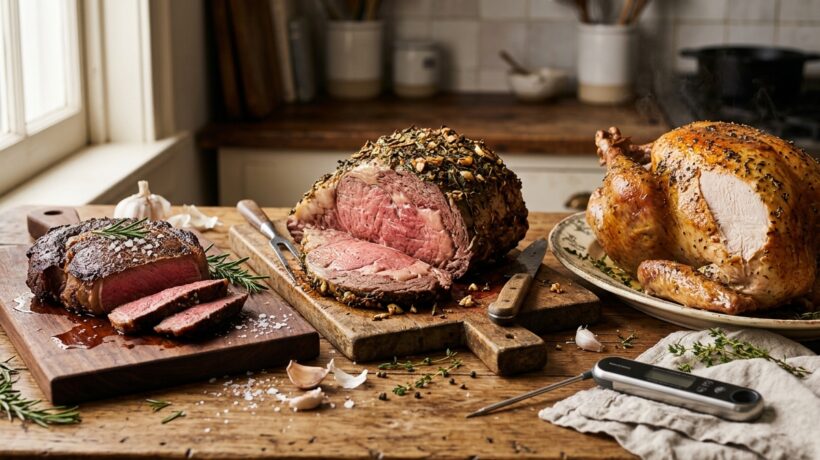
A perfectly cooked steak, a juicy Sunday roast, and a golden turkey are among the most rewarding things to serve, yet they are also the easiest to ruin. The culprit is rarely seasoning or technique—it is guesswork. Relying on time alone ignores the many variables that affect how fast meat cooks, from thickness and starting temperature to the quirks of your oven. That is why the single most reliable upgrade any home cook can make is cooking with a thermometer //greatestjournal.com/food-and-fruits/how-to-use-meat-thermometer-correctly-for-perfect-cooking/ instead of trusting the clock. This guide shows you exactly how to apply that principle to steak, roast, and turkey, with the target temperatures, techniques, and troubleshooting that actually matter.
Quick Answer
Use an instant-read thermometer and pull meat before it reaches your final target, then let it rest. Steak: 130–135°F for medium-rare. Beef roast: 135°F for medium-rare, up to 150°F for medium. Turkey: 165°F in the breast. Always insert the probe into the thickest part, avoiding bone and fat, and account for carryover cooking that adds 5–10°F during rest.
Key Takeaways
- Internal temperature, not time, is the only reliable way to judge doneness because ovens vary and meat thickness changes cooking speed.
- Carryover cooking raises internal temperature 5–10°F after you pull meat from the heat, so pull it slightly below your target.
- Each meat has a specific target: steak and beef roast are judged by your preferred doneness, while turkey must reach a safe 165°F in the breast.
- Probe placement is the most common mistake—always aim for the thickest part and avoid bone, fat, and gristle.
- Resting is not optional; it lets juices redistribute and finishes the cooking process evenly.
Why Internal Temperature Beats Timing Every Time
Recipe timings are estimates, not guarantees. A steak that takes eight minutes on one stove may take twelve on another. A roast placed in a cold pan cooks differently than one in a preheated oven. The shape of the meat, whether it was refrigerated or brought toward room temperature, and how often you open the oven door all shift the outcome.
Internal temperature sidesteps all of this. Because bacteria and foodborne illness are tied to temperature, and because doneness—how pink or juicy the meat is—is also a function of temperature, measuring it directly gives you a real answer instead of a hopeful guess. Once you learn a handful of target numbers, you can cook the same cut in any kitchen and expect the same result.
Essential Tools and How to Use Them
You do not need expensive equipment, but the thermometer you choose does affect accuracy and speed.
- Instant-read digital thermometer: The most versatile choice. It reads in a few seconds and works for thin steaks and thick roasts alike.
- Leave-in probe thermometer: Ideal for roasts and turkey. Insert it before cooking and monitor the temperature without opening the oven.
- Dial thermometers: Affordable but slower and often less precise. They require regular calibration.
Regardless of type, always insert the probe into the thickest part of the meat. For steak, approach from the side. For roast and turkey, angle toward the center. Keep the tip away from bone, which heats faster and gives a false high reading, and away from large pockets of fat.
Target Temperatures at a Glance
The table below summarizes the internal temperatures that matter most. Pull meat from the heat a few degrees below the final target to allow for carryover cooking.
| Meat | Doneness | Final Internal Temperature | Pull From Heat At |
|---|---|---|---|
| Steak / Beef roast | Rare | 125°F | 120°F |
| Steak / Beef roast | Medium-rare | 130–135°F | 125–130°F |
| Steak / Beef roast | Medium | 140–145°F | 135–140°F |
| Steak / Beef roast | Medium-well | 150–155°F | 145–150°F |
| Turkey breast | Safe / done | 165°F | 160°F |
| Turkey thigh | Safe / tender | 175°F | 170°F |
Turkey is the exception to the “personal preference” rule. Poultry should reach 165°F in the breast for safety. Thigh meat benefits from cooking to a slightly higher temperature because the connective tissue breaks down and the meat becomes more tender.
How to Cook a Perfect Steak
Steak is fast, which means small temperature differences happen quickly. A reliable approach is the reverse sear or the stovetop-to-oven method, both of which give you more control than a screaming-hot pan alone.
- Pat the steak dry and season it well.
- Sear in a hot pan for color, then finish in a moderate oven, or cook low and slow first and sear at the end.
- Insert the thermometer from the side into the center and check as you approach your target.
- Pull 5°F below your target and rest for 5–10 minutes.
Thin cuts like skirt or flank steak are hard to probe accurately because the probe may pass through to the pan. With those, cook by feel and timing, and use the thermometer more as a confirmation if the cut is thick enough.
How to Cook a Perfect Beef Roast
A roast is forgiving in the sense that you have time to react, but it is easy to overshoot because a large piece of meat holds heat and continues cooking after it leaves the oven. A leave-in probe thermometer earns its keep here.
Set the probe in the thickest part, away from bone. Roast at a moderate temperature—typically 325–350°F—and monitor. When the reading approaches 5–10°F below your target, remove the roast and tent it loosely with foil. The temperature will continue to climb during the rest.
Resting a roast for 15–20 minutes is important not just for juiciness but for even doneness. Slicing too early releases juices and leaves you with drier meat.
How to Cook a Perfect Turkey
Turkey has two challenges: the breast and thigh cook at different rates, and safety matters more than preference. The breast is lean and dries out quickly, while the thigh is fattier and needs more heat to become tender.
Check both the breast and the thigh separately. The breast should hit 165°F, and the thigh around 175°F. If the breast reaches temperature first, you can tent it or remove it while the thigh finishes, though this is tricky with a whole bird.
For a whole turkey, probe the thickest part of the breast without touching the breastbone. Many cooks also check the thigh near the joint. If you are spatchcocking or cutting the bird into parts, cooking each piece to its own target is much easier and produces better results.
Common Mistakes That Ruin Doneness
- Probing bone or fat: This gives a false high reading and tricks you into pulling meat too early.
- Ignoring carryover cooking: Pulling at your exact final target means you will overshoot during rest.
- Checking too often with a leave-in probe removed: Each time you open the oven, heat escapes and cooking slows.
- Not resting: Skip the rest, and you lose juices and even doneness.
- Relying on color alone: Visual cues are unreliable, especially in dim light or with dark marinades.
Troubleshooting: When the Reading Seems Wrong
If your thermometer gives a reading that does not match what you expect, consider these possibilities. An ice-water test can confirm whether your thermometer is calibrated—crushed ice and water should read 32°F. If it is off, adjust or replace it. A reading that jumps around may mean the probe tip is in fat or touching bone. A reading that seems too low for the cooking time may simply mean the meat is thicker than you estimated or the oven is running cool.
When in doubt, take multiple readings in different spots and use the lowest one as your guide.
Frequently Asked Questions
Do I really need a thermometer to cook steak?
You can cook steak without one, but a thermometer removes guesswork and gives consistent results. For thick cuts especially, it is the difference between a reliable medium-rare and a coin flip.
What temperature should I pull a turkey out of the oven?
Pull the turkey when the breast reads about 160°F. Carryover cooking during the rest will bring it to the safe 165°F. Check the thigh separately and aim for around 170–175°F.
How long should meat rest, and does it change the temperature?
Steak rests 5–10 minutes, roasts 15–20 minutes, and turkey 20–30 minutes. During that time, internal temperature typically rises 5–10°F, which is why you pull slightly below target.
Can I use the same thermometer for steak and a whole turkey?
Yes. An instant-read digital thermometer works for both, though a leave-in probe is more convenient for a turkey because you can monitor it without opening the oven repeatedly.
Is it safe to eat steak medium-rare?
Whole cuts of beef are generally considered safe at medium-rare because bacteria live on the surface, which gets seared. Ground beef is different and should be cooked to 160°F.
Why did my roast come out dry even though it hit the right temperature?
Likely causes are skipping the rest, slicing too soon, or cooking at too high a temperature. Even at the correct internal temperature, rapid cooking can toughen meat and push moisture out.
Conclusion
Perfect doneness comes down to one habit: measuring instead of guessing. Learn your target temperatures, pull meat slightly before it reaches them, and always let it rest. Steak, roast, and turkey each have their own quirks—steak is fast and unforgiving, roast is slow and carries over heat, and turkey demands safety and even cooking across two different types of meat. Master these basics, and you will stop serving disappointing meat and start cooking with confidence every time.